Insight 01
From access to capacity
The market is moving beyond model access alone. Durable value is concentrating in deployable capacity tied to power, site, and governance readiness.
Directional view — illustrative, not a forecast.
EGIL’s perspective on the market shift from AI access to AI capacity, and on why energy, governance, readiness, agentic control, and deployment discipline are becoming central to the next era of enterprise AI.
EGIL is leading a market transition, and its experts interpret market-defining new signals regularly, helping enterprises, partners, and institutions understand why governed, energy-anchored sovereign infrastructure is becoming the new requirement.
The market is moving beyond model access alone. Durable value is concentrating in deployable capacity tied to power, site, and governance readiness.
Directional view — illustrative, not a forecast.
Control, speed, efficiency, and resilience are not abstract brand claims. They are the business outcomes serious institutions are buying when they buy infrastructure confidence.
Whoever controls energized capacity controls the deployment timeline. That makes power one of the highest-leverage layers in AI economics.
Illustrative sequencing — not a schedule commitment.
As open models approach closed-model performance, advantage shifts away from model access alone and toward the environment where models run. Sovereign infrastructure becomes the differentiator: power certainty, governed data boundaries, deployment control, and operating discipline institutions can trust at scale.
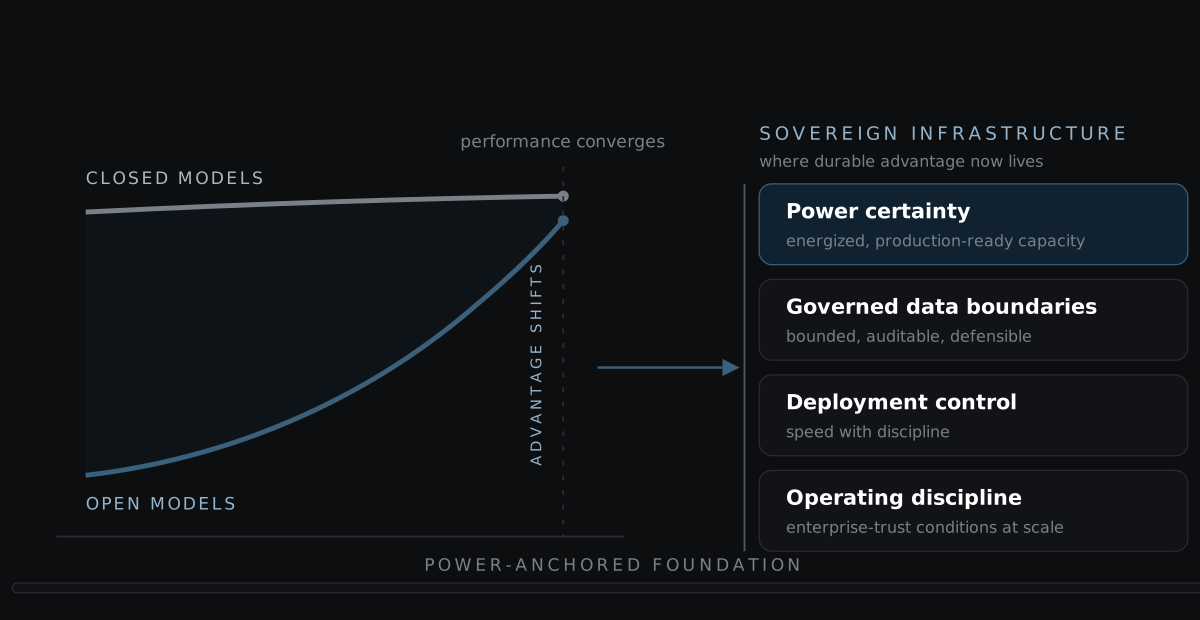
As open models approach closed-model standards, the durable strategic premium shifts to sovereign operating environments.
As enterprises begin deploying autonomous agents across sensitive workflows, sovereignty stops being a strategic preference and becomes an operating requirement. Governing a new digital workforce requires bounded environments, auditable permissions, clear escalation paths, and infrastructure leaders can trust at enterprise scale.
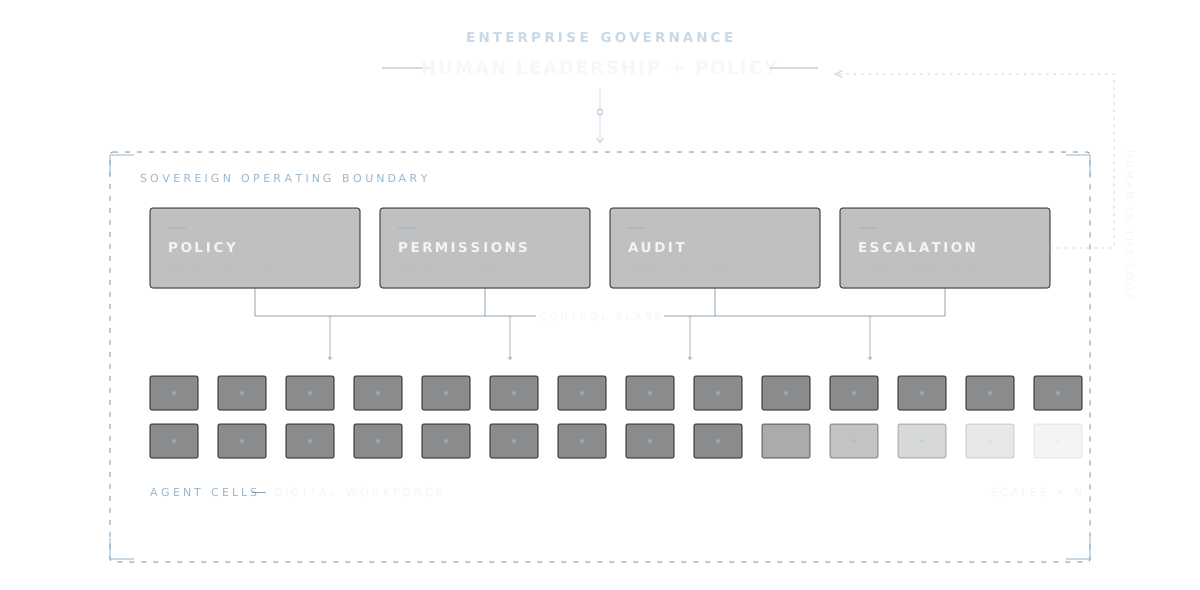
Autonomous agents increase the need for governed, sovereign operating environments.
When hyperscalers, model leaders, and large enterprises all move toward tighter infrastructure control, that is usually a signal that the next constraint is no longer software alone. For enterprise clients, that means waiting to secure infrastructure conditions can become more expensive than deciding on a model. For investors, it means durable value shifts toward platforms that can convert market urgency into real, governed deployment capacity.
The economic question is no longer just what a model can do. It is whether an institution can run it reliably, efficiently, and at enterprise scale. Power certainty, modular rollout logic, utilization discipline, and operating boundaries increasingly determine cost per token, deployment speed, and the confidence to move from pilot budgets to production budgets.
As models become more capable and more open, the operating environment around them matters more, not less. Regulated institutions and government-facing organizations need bounded data domains, auditable controls, and deployment architectures they can defend internally and externally. The autonomous agentic era intensifies that requirement because a growing digital workforce must be governed, supervised, and contained with confidence. Sovereignty is becoming a procurement requirement, not a philosophical preference.
The next generation of AI infrastructure will be judged not only by throughput, but by whether communities, operators, enterprises, and capital providers can trust how it is built and governed. Institutions increasingly want intelligent infrastructure that is technically strong, socially legitimate, and durable enough to support long-horizon adoption rather than one-cycle experimentation.
EGIL shares deeper market and platform views directly with serious enterprise, capital, and strategic counterparties.